
What Afghanistan’s Shift from Cash to Digital Means for Onboarding
As Afghanistan moves to cash-free transactions towards a more digitally connected economy, businesses face a new challenge: creating secure onboarding, accessible, and simple enough.
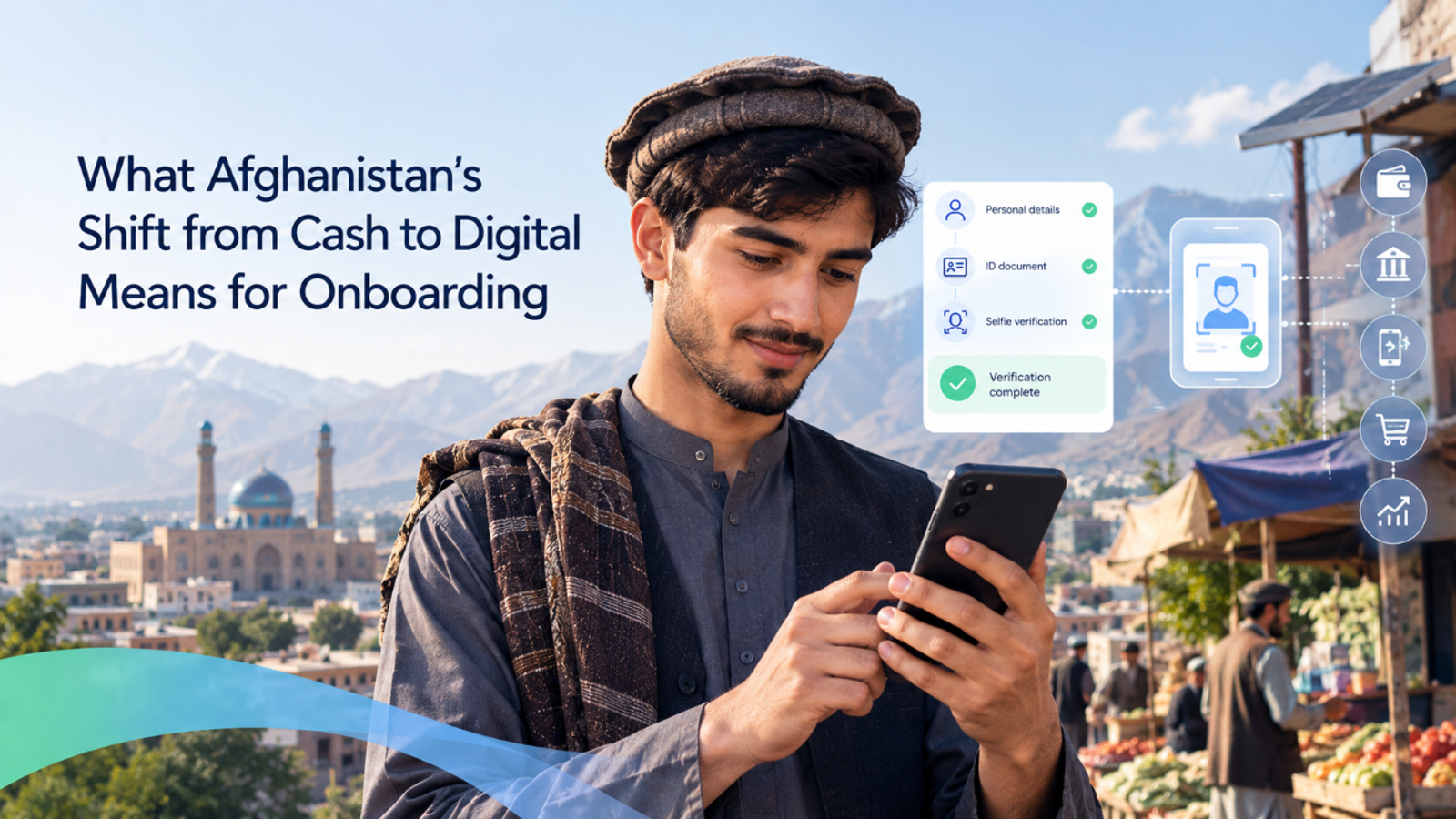
For decades, cash has been at the centre of everyday transactions in Afghanistan.
Whether paying a local merchant, sending money to family, accessing a service, or conducting business, physical cash has often been the simplest and most familiar option.
But the way people access financial and digital services is changing.
As mobile connectivity, digital platforms, electronic payments, and online services continue to develop, Afghanistan is moving towards a more digitally connected economy.
That transition creates an important challenge for businesses:
How do you onboard people who may be using digital financial services for the first time?
The answer is not simply to digitise existing processes.
It is to rethink onboarding from the ground up.
Digital access starts with identity
In a cash-based environment, a transaction can often happen without creating a persistent digital relationship between the customer and the service provider.
Digital services work differently.
A wallet, fintech platform, marketplace, digital bank, e-government service, or online business needs to know who its users are.
That makes identity verification fundamental to digital onboarding.
Customers may need to provide personal information, verify an identity document, complete a selfie or face verification, and establish an account before they can access a service.
For businesses, this creates stronger controls against fraud and supports regulatory requirements.
For customers, however, it can introduce a completely new experience.
The challenge is making that experience simple.
The first digital experience matters
For someone accustomed to cash transactions, opening a digital account can involve unfamiliar steps.
They may be asked to:
- Enter personal information
- Provide an identity document
- Take photographs of their documents
- Complete facial verification
- Create security credentials
- Verify a mobile number
- Understand digital terms and permissions
None of these steps are necessarily complicated on their own.
But together, they can become a significant barrier if the experience is not designed carefully.
This is particularly important when digital services are reaching users who have limited experience with formal digital financial products.
The onboarding process is part of the product.
If it is confusing, users may never reach the service itself.
Afghanistan needs onboarding designed for its users
There is no universal onboarding experience.
A process designed for a highly connected market with widespread smartphone access, strong digital literacy, and extensive online banking adoption cannot simply be copied into another environment.
Afghanistan has its own realities.
Users may have different levels of digital literacy. Devices and connectivity can vary. Documentation may differ between individuals. Languages and accessibility requirements matter.
These factors should be considered when designing digital services from the beginning.
Good onboarding should therefore be:
Mobile-first.
The smartphone is often the primary gateway to digital services.
Simple.
Users should understand what they need to do without specialist knowledge.
Multilingual.
Instructions should be available in the languages users actually use.
Resilient.
A temporary connectivity problem or failed document scan should not mean starting from the beginning.
Trustworthy.
Users need to understand why their information is being collected and how it will be protected.
KYC cannot become the new barrier
Digital transformation can solve one problem while creating another.
If businesses replace a physical registration process with a complicated digital KYC journey, they may simply move the friction from the physical world to the digital one.
A user might no longer need to visit an office—but could instead abandon the application after three failed attempts to photograph their identity document.
That is not successful digital transformation.
Effective KYC should make onboarding easier without compromising security.
Technology can help by automating document checks, extracting information, supporting biometric verification, identifying inconsistencies, and reducing manual processes.
But technology alone is not enough.
The experience around the technology matters just as much.
Trust becomes part of the onboarding process
Digital financial services require users to trust something they cannot physically see.
With cash, the transaction is tangible.
With a digital wallet or account, users are trusting a platform to hold information, process transactions, protect their identity, and provide access when they need it.
That makes transparency particularly important.
Users should be able to understand:
- Why their identity is being verified
- What information is being collected
- How their information will be protected
- What happens after verification
- What to do if verification fails
- How they can access support
Trust should not be treated as a marketing feature added after the product is built.
Trust is part of the onboarding architecture.
Digital onboarding can expand access
Done well, digital onboarding can remove barriers that previously required physical presence.
A customer should not necessarily have to travel to a branch, complete multiple paper forms, or wait for manual processing simply to establish access to a digital service.
Identity verification can happen remotely.
Account creation can happen remotely.
Services can become available through a mobile device.
This creates opportunities well beyond financial services.
The same infrastructure can support onboarding for:
- Digital wallets
- Fintech platforms
- Telecommunications services
- E-commerce
- Insurance
- Healthcare platforms
- Education services
- E-government
- Business services
A reliable digital identity and verification layer can therefore become foundational infrastructure for a wider digital economy.
Businesses also benefit from better onboarding
The value of digital onboarding is not only for customers.
Businesses can reduce manual administration, standardise customer verification, improve data quality, identify suspicious activity earlier, and potentially onboard customers at a much larger scale.
Instead of building separate processes for every channel, organisations can create a consistent identity and verification journey across their digital services.
This becomes particularly valuable as businesses grow.
The more customers a platform serves, the more expensive inefficient onboarding becomes.
Every unnecessary manual step eventually becomes an operational cost.
From cash-first to digital-first
Afghanistan's digital transition is not simply about replacing banknotes with screens.
It is about changing how people establish relationships with businesses and services.
In a cash-first environment, access can be largely transactional.
In a digital-first environment, access begins with identity.
That makes onboarding one of the most important foundations of the digital economy.
The organisations that succeed will not necessarily be those that add the most technology.
They will be the ones that combine security, compliance, accessibility, and simplicity into an experience people can trust.
Building the next generation of digital access
Afghanistan's digital economy has the opportunity to develop in ways that are designed around local needs rather than simply replicating systems built for other markets.
That means creating digital services that work for real users, on real devices, across different levels of connectivity and digital literacy.
It means treating KYC as more than a compliance checkbox.
And it means recognising that a customer’s first interaction with a digital service can determine whether they ever become a customer.
At Bawarii, we believe digital transformation begins with access.
When identity verification is secure, simple, and user-focused, onboarding stops being a barrier and becomes the gateway to digital services.